
Work Performed
Field challenge
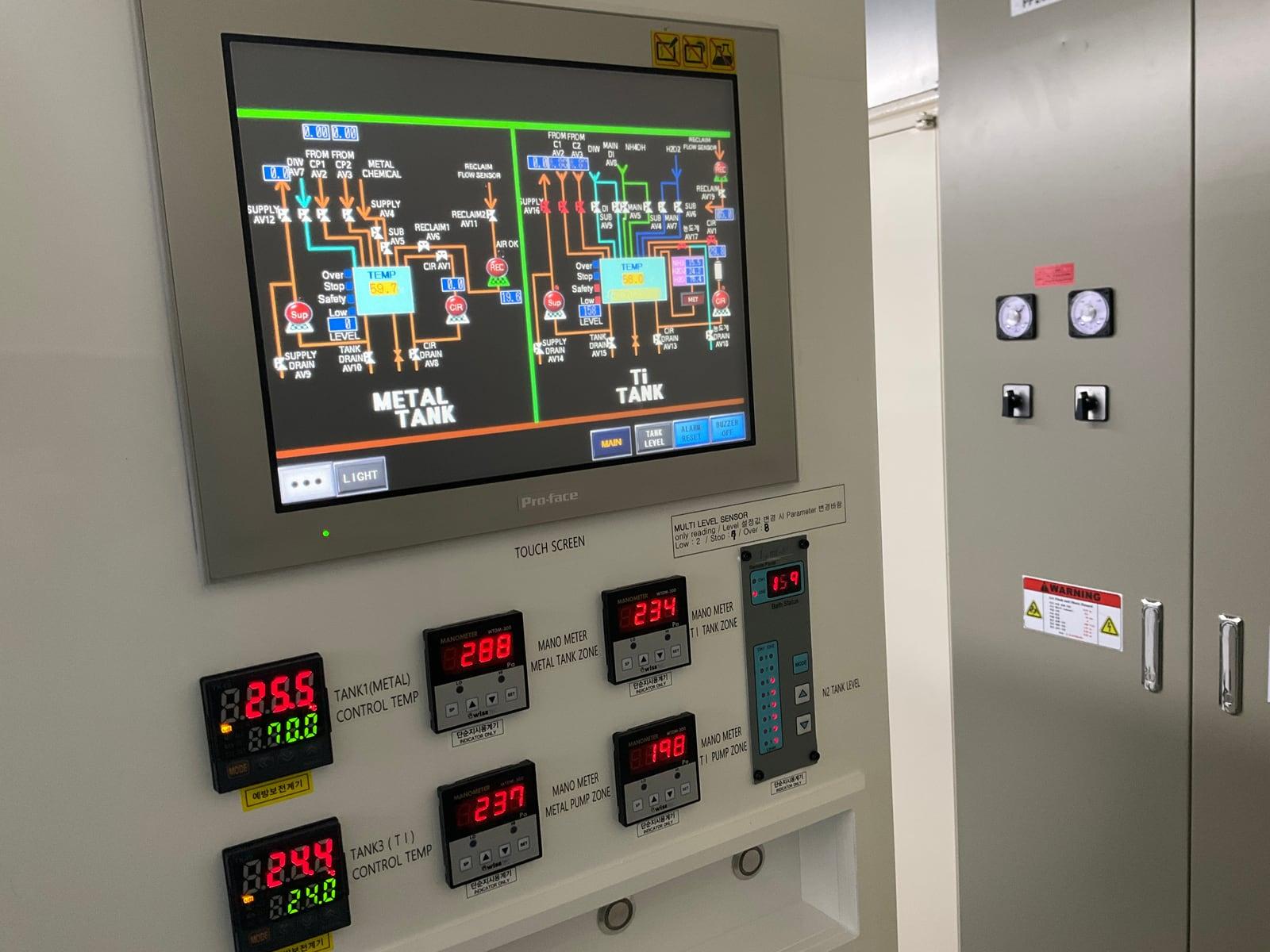
A new SAT chemical etching tool required a local supply controller that could exchange chemical-change requests and standby signals with the main equipment. Following a chemical change, the system had to confirm that both concentration and temperature reached their setpoints before declaring the supply ready, while also monitoring flow and abnormal conditions.
Work / Solution
JUNSEMI performed the electrical work, control programming and SAT interface, excluding mechanical and base-hardware fabrication. A chemical-change request from the SAT initiates the tank sequence; the supply changes to complete and standby only after the new-generation HORIBA SC1 concentration monitor and temperature feedback reach their respective setpoints. During processing, chemicals are supplied automatically on request with the required interlocks. Immersion-type Teflon heaters are controlled by PID through HANYOUNG NUX TPR units. KEYENCE clamp-on flow meters were applied to this equipment type for JUNSEMI's first time, allowing flow monitoring without direct contact with the fluid. Matching touch panels were installed at the local supply unit and beside the SAT tool so operators can check the same system status from either location.
Key functions and engineering
• Two-tank sequence: Tank 1 for metal etchant; Tank 2 for NH4OH, H2O2 and DI water
• SAT chemical-change request and standby signal interface
• Chemical change, condition confirmation, automatic supply and interlocks
• HORIBA SC1 concentration monitoring and setpoint verification
• PID temperature control with immersion Teflon heaters and HANYOUNG NUX TPR units
• KEYENCE clamp-on flow monitoring
• Two synchronized operator touch panels at the local unit and SAT tool
Verified Result
Completed the electrical controls and SAT integration, then verified the chemical-change sequence, concentration and temperature setpoint checks, standby transition, automatic supply, interlocks and status display on both touch panels. No numerical process-improvement claim is made because quantified data was not available.